
Eternity Rings: Full or Half, and When to Give One
An eternity ring is a band set with stones all or part of the way round. How full and half versions differ in wear, sizing and cost, and when to give one.
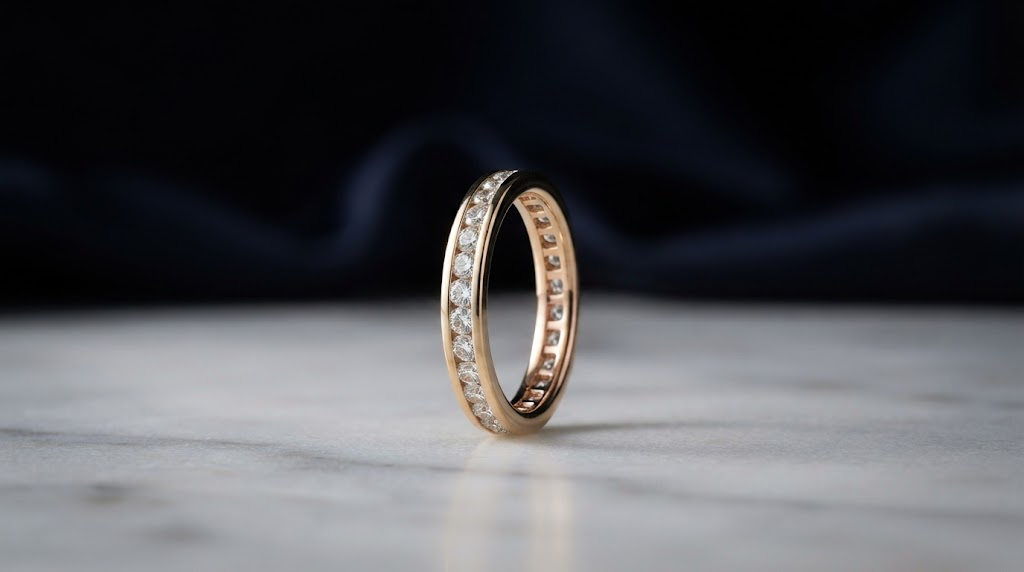
An eternity ring is a band with stones set around it, either all the way round or across the top only. The form is simple and the symbolism is obvious, which is why it has become the standard gift for an anniversary or the birth of a child. It is also a ring with a few practical quirks that are worth understanding before choosing one.
Full eternity
Stones run the entire circumference. Seen from any angle, the ring is stones.
The appeal. It never needs turning. Whatever position it settles in on the finger, it looks the same. It is the more generous and more traditional version.
Resizing is close to impossible. There is no plain metal to cut and stretch, so a full eternity ring has to be made in the right size and stay there. Fingers change with age, weight and pregnancy. A ring given at thirty may not fit at fifty, and the only remedy is to remake it.
Wear on the underside. The stones under the finger take all the contact with desks, bags and steering wheels. Small stones set in beads or shared prongs loosen there first. Channel setting, where the stones sit in a groove between two walls of metal, is the most robust option for a full eternity.
Cost. Roughly twice the stones of a half eternity, and every one of them must match.
Half eternity
Stones across the top third to half of the band; plain metal underneath.
Comfort. The plain section sits between the fingers, which is where a full eternity is felt most.
It can be resized, within a size or so, by working the plain section.
Durability. The stones are on top, where they are seen and least knocked.
The one drawback. It can rotate, and then the plain section shows. Rings with a slightly heavier shank, or with a subtle flat inside, turn less.
For most people the half eternity is the sensible choice. It is what we make more often, and few owners regret it.
Stone choices
Diamonds are the default, in rounds or baguettes, and increasingly in lab-grown for the larger sizes. Coloured stones work well, particularly sapphires and rubies, because they are hard enough for a band that is knocked. Alternating diamonds and coloured stones is a classic arrangement. Softer stones such as emerald are a poor choice for a band worn daily.
Uniformity matters more than in almost any other ring. Twenty stones of slightly different colour or size look wrong in a straight line. A good workshop calibrates them to within a tenth of a millimetre.
Setting styles
Channel. Stones held between two metal walls. Most secure, smoothest to wear, slightly less light into the stones.
Shared prong. Each prong holds two neighbouring stones. More light, more sparkle, more maintenance.
Bead or pavé. Tiny stones held by raised beads of metal. The most brilliant, the most delicate.
Bezel. Each stone in its own metal rim. Very durable, very modern-looking, and it uses a little more metal.
When it is given
There is no rule, and any occasion works. The customary ones are a first, fifth or tenth anniversary, the birth of a first child, and, in some families, a significant birthday. In Malaysia it is also a common gift alongside a full-month celebration.
It is normally worn on the same finger as the engagement and wedding rings, either between them or on the outside, so its width and profile should be chosen against the rings it will sit with. Bringing those rings to the consultation saves guessing.
One last practical point
A full eternity ring is the one piece of jewellery where getting the size exactly right at the outset is everything. Measure at the end of the day, in warm weather, more than once.
Book a complimentary design consultation at the C'Garden atelier, The MET Corporate Towers, Kuala Lumpur: 010-766 7448 · hq@cgarden.com.my
C'Garden is an independent bespoke jeweller in Kuala Lumpur. We are not affiliated with, endorsed by, sponsored by or certified by any organisation, laboratory or brand named in this article. Third-party names are used only to refer factually to those organisations and their published standards. All text and imagery in this article is original work created by C'Garden.
Reference
Gemological Institute of America. (n.d.). Diamond quality factors. GIA. https://www.gia.edu/diamond-quality-factor
Jewelers of America. (n.d.). Buying jewelry. Jewelers of America. https://www.jewelers.org/buying-jewelry
All journal entries